

Tour operators have spent years collecting reviews. Between them, the 120 operators in our research hold 668,123 reviews. When we checked what AI assistants can actually read on their tour pages, the answer was 1,107. That is 0.16%, or fewer than 1 review in every 600.
Travellers are starting to ask ChatGPT, Claude, Perplexity and Google’s AI for the best tour in a city, rather than scrolling through search results. Those assistants recommend what they can read and verify. Right now, almost everything that proves a tour is great is invisible to them.
This is the first edition of the TripAdmit AI Visibility Benchmark. It measures how many of an operator’s reviews AI can read on the operator’s own tour page, and why the rest are missed.
Key findings
- 0.16% of tour operators’ reviews can be read by AI: 1,107 of 668,123.
- For 47 of 120 operators (39%), AI could read none of their reviews.
- For 89% of operators, AI could read less than 5% of their reviews. Only 1 operator had every review readable.
- The operators that do show reviews hold 5,567 reviews on average, but AI could read a median of just 5.
- Neither approach works. AI could read less than 1% of the reviews for 70% of operators using a review widget and 60% of those that built their own review section.
- Nearly 4 in 10 operators that show reviews mix reviews of their company into their tour pages. Those reviews say nothing about the tour itself.
- Multi-day and day-tour operators face the same problem: AI could read 0.11% and 0.18% of their reviews.
How we did the research
Between 3 September and 25 October 2026 we audited one tour or activity page for each of 120 tour operators: 42 multi-day operators and 78 day-tour and activity operators. They operate across Europe, North America, Australia, Iceland and the Middle East, and range from small local businesses to some of the best-known names in travel.
We read every page in two ways:
- As it is first sent. This is the raw page, before any scripts run. It is what most AI crawlers read.
- As a browser builds it. This is the page after its scripts run, but without clicking or scrolling, because crawlers don’t click or scroll.
We also requested every page as 14 AI and search crawlers, including those behind ChatGPT, Claude, Perplexity, Google and Bing, to check whether they were let in.
We then counted the reviews AI could read as text on the page and compared that with the number of reviews the operator holds.
Finding 1: for 47 operators, AI could read none of the reviews
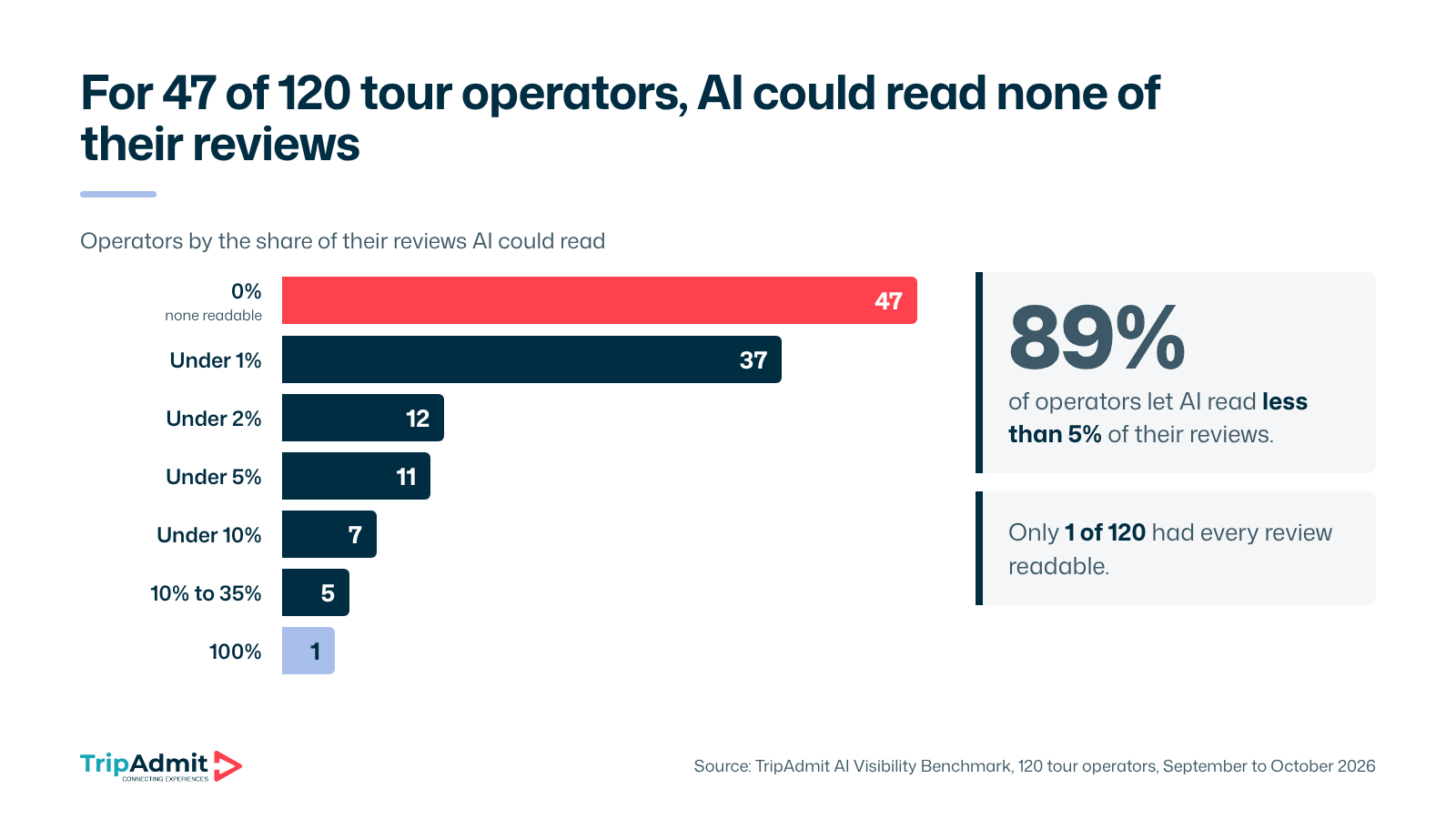
For 47 of the 120 operators, AI could read none of their reviews. Only 14 of them show no reviews on the tour page or homepage. The other 33 do show reviews, but in a way AI can’t read.
A further 37 operators let AI read less than 1%. Taken together, 89% of operators let AI read less than 5% of their reviews. Only 6 operators let AI read 10% or more, and only 1 operator had every review readable.
Finding 2: even where reviews are shown, AI reads a median of 5

Showing reviews is not the same as AI being able to read them. Of the 105 operators that show reviews on their website, AI could read none at all for 33 and 5 or fewer for another 32. The median was 5 readable reviews, against an average of 5,567 reviews held per operator.
Only 2 of the 105 operators let AI read more than 20 reviews. In other words, an AI assistant judging a tour from the operator’s own page has a handful of quotes to go on, however many thousands of reviews the operator has earned.
Finding 3: nearly half use a review widget, and four in ten built their own
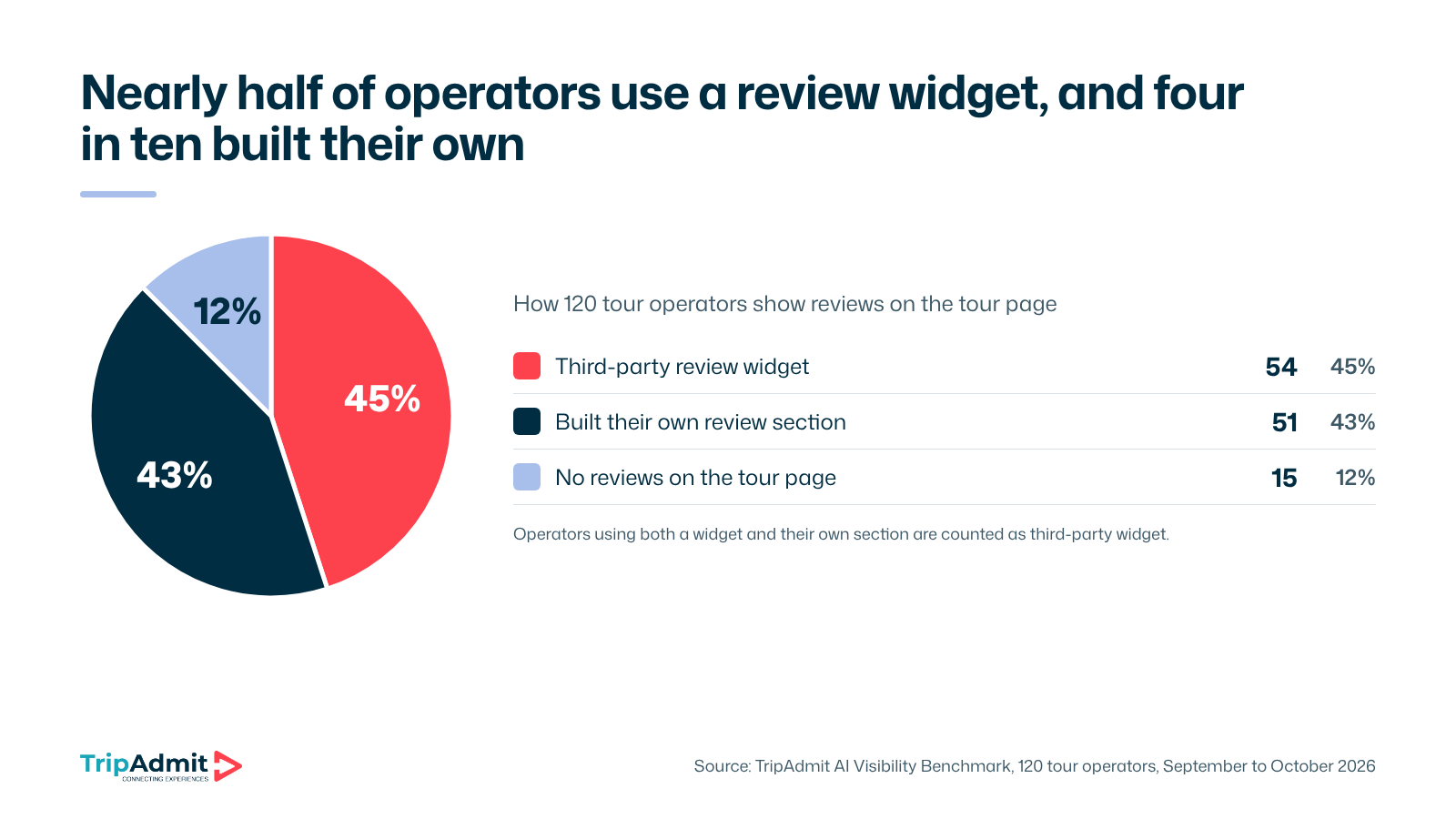
Operators split almost evenly between two approaches. 54 operators (45%) use a third-party review widget, a box supplied by a review company that pulls reviews onto the page. 51 operators (43%) built their own review section, either typed into the website or fed from their own review system. The remaining 15 (12%) show no reviews on the tour page.
The widget market is spread across many providers. Trustindex is the most used, on 14 operators’ pages, followed by Elfsight on 10, and Feefo and Trustpilot on 7 each. Another 19 widgets come from a long tail of other providers and plug-ins.

Feefo stands out in another way. A further 8 operators show Feefo reviews in a section of their own design rather than in Feefo’s widget, which makes Feefo the most common source of reviews among multi-day operators.
Finding 4: neither way of showing reviews works for AI

The question we hear most from operators is whether they are better off with a third-party widget or building it themselves. For AI, the honest answer is that neither works as things stand.
- Review widgets: for 38 of the 54 operators (70%), AI could read less than 1% of the reviews. Widgets are built to look good to a human visitor. Most draw their reviews with scripts after the page loads, which AI crawlers don’t wait for.
- Own-built sections: for 31 of the 51 operators (60%), AI could read less than 1%. These sections are usually readable, but they hold very few reviews: a slider of 3 to 10 hand-picked quotes is typical.
Widgets hide the reviews; own-built sections show too few. Either way, the reviews AI needs to recommend a tour never reach it.
Finding 5: nearly 4 in 10 operators mix company reviews into their tour pages
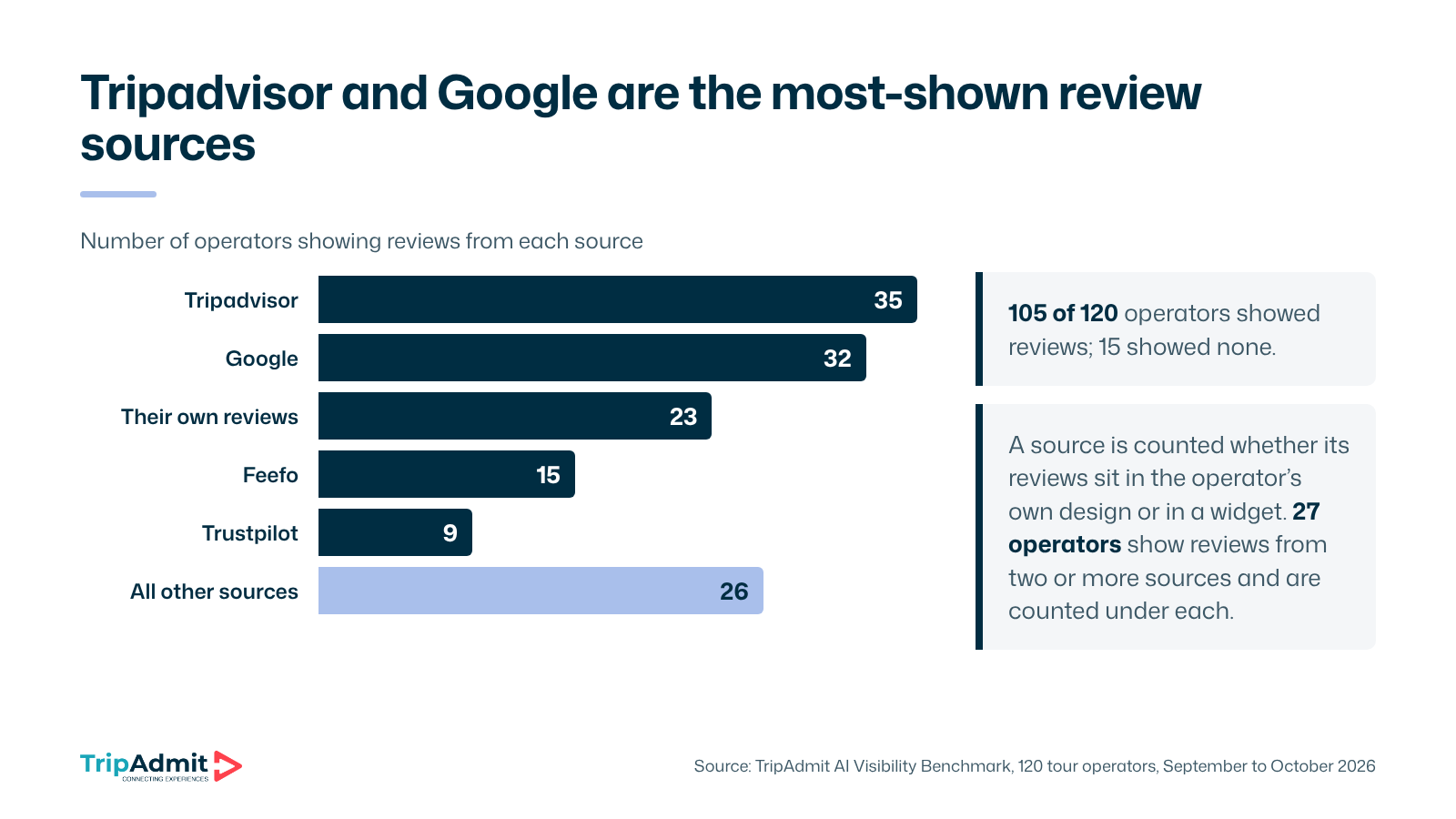
Tripadvisor and Google are the review sources operators show most, on 35 and 32 operators’ pages. Next come operators’ own reviews (23), Feefo (15) and Trustpilot (9). 27 operators show reviews from two or more sources.
Where a review comes from matters, because some sources only describe the company. A Google review is a review of the business’s Google profile, not of a particular tour. Trustpilot’s standard reviews are also reviews of the company; reviews of individual products are a separate option, and only 1 of the 9 operators showing Trustpilot reviews used it.
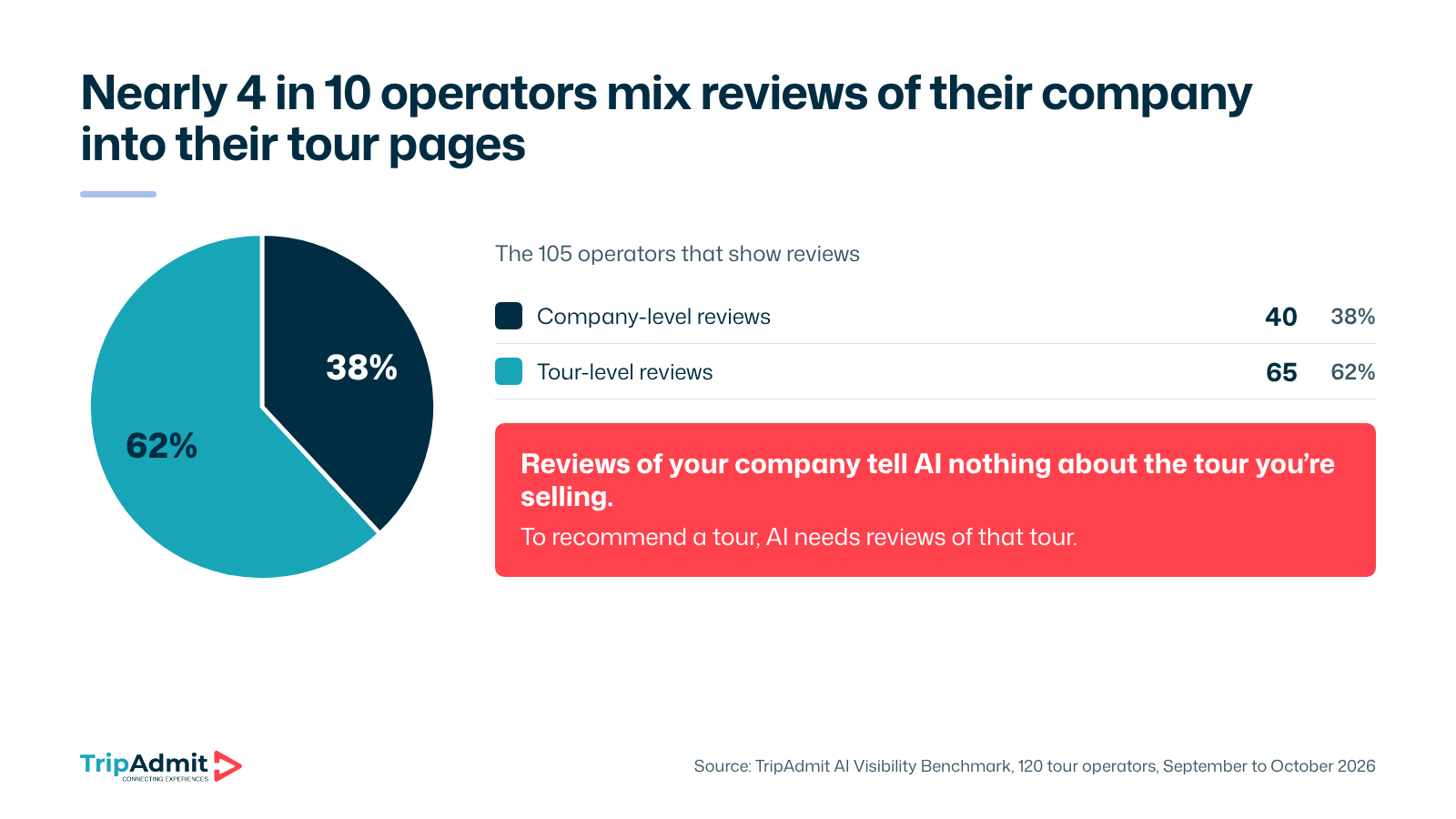
Of the 105 operators that show reviews, 40 (38%) show Google or Trustpilot reviews on their tour pages. A review that says “great company, lovely staff” may persuade a human visitor, but it tells AI nothing about whether this food tour in Rome or this 10-day trip through Peru is any good. To recommend a tour, AI needs reviews of that tour.
Finding 6: multi-day and day-tour operators face the same problem

The problem is not limited to one corner of the industry. The 42 multi-day operators hold 142,319 reviews between them, and AI could read 163 (0.11%). For 47% of them, AI could read none at all. Many multi-day operators collect detailed reviews for each trip, often through Feefo, and then show them in a tab, a pop-up or a widget that AI never sees.
The 78 day-tour and activity operators hold 525,804 reviews, and AI could read 944 (0.18%). For 34% of them, AI could read none.
Why AI can’t read most tour reviews
An AI crawler reads a web page very differently from a person. It usually takes the page as it is first sent, reads the text, and moves on. It doesn’t wait for scripts to finish, doesn’t scroll, and doesn’t click. Almost every reason we found comes back to that.
- Only a handful of reviews are published. Most tour pages show between 3 and 20 reviews, usually hand-picked or the newest few. The other hundreds or thousands are never on the page. This affects both widgets and own-built sections, and it is the single biggest reason so little is readable.
- Reviews are drawn by a script after the page loads. Most review widgets send an empty box with the page and fill it with reviews a moment later using JavaScript. A person sees the reviews; a crawler reading the page as first sent sees the empty box.
- Reviews only load when a visitor scrolls. To keep pages fast, at least 12 operators’ widgets wait until the visitor scrolls down before fetching any reviews. A crawler never scrolls, so on these pages it finds no reviews even when it runs the page’s scripts.
- Reviews sit inside a frame marked “do not index”. Some widgets show reviews in a frame: a separate small web page from the review company, placed inside the operator’s page. Trustpilot’s TrustBox widgets work this way, and the frame carries a “noindex” tag that tells search engines and AI crawlers not to read it. On at least 7 operators’ pages, the reviews were inside a frame.
- Reviews are sealed off in the page’s code. Some widgets, including Feefo’s newer widgets, Bazaarvoice and Wix’s Google reviews app, place reviews in a sealed-off part of the page called the shadow DOM. Many crawlers and text readers skip it.
- Reviews are hidden behind a click. “Load more” buttons, review tabs and “Read all reviews” links that open a pop-up all need a click. We found reviews behind a click on at least 17 operators’ pages, and anything behind a click is invisible to AI.
- The reviews are about the company, not the tour. As Finding 5 shows, 4 in 10 operators that show reviews include Google or Trustpilot reviews of the business. AI can read some of these, but they don’t help it judge the tour.
- Reviews are pictures, not text. Star ratings, award badges and, on one site, screenshots of reviews are images. AI reads the words on a page, not words inside a picture.
- The widget shows nothing at all. 4 operators had a review widget installed that displayed no reviews, for reasons such as an empty data feed, a widget set up for a different product, or a closed review account.
- The AI crawler is turned away. On 25 of the 82 sites where we logged each crawler, at least one of the 14 AI and search crawlers was blocked. Anthropic’s ClaudeBot was blocked on 9 sites and OpenAI’s GPTBot on 7, and 2 sites turned away every crawler we tried. This is often a default bot-protection setting in a hosting or security service, not a deliberate choice.
Why it matters: AI can only recommend what it can read
Ask an AI assistant for “the best food tour in Rome” and it will recommend the tours it has evidence for. If it can’t read your reviews, it will recommend a competitor or, if you’re lucky, your own tour on an OTA, where you pay commission on the booking.
The reviews already exist. Operators have earned them over years, often in their thousands. The gap is not a lack of happy customers; it is that the way reviews are shown on tour pages was designed for human visitors, before AI assistants started choosing which tours travellers see.
What operators can do
- Put tour reviews on the page as text. Reviews should be in the page as it is first sent, not drawn in later by a script.
- Show more than a handful. A few quotes can’t compete with a page that lets AI read hundreds of genuine reviews of the same tour.
- Don’t hide them. Avoid putting reviews only behind a click, a scroll, a tab, a pop-up or a frame.
- Keep tour reviews separate from company reviews. Show reviews of the tour on the tour page, so AI can tell what each tour is like.
- Check who you’re turning away. Make sure your hosting or security settings let the AI crawlers you want to be found by read your site.
How many of your reviews can AI read?
Get in touch and we’ll audit one of your tour pages for free, with the same 14 AI and search crawlers we used in this research, and show you exactly what they can see.
Get Reviews. Get Recommended. Sell More. TripAdmit.com
Source: TripAdmit AI Visibility Benchmark, 120 tour operators, 3 September to 25 October 2026.